
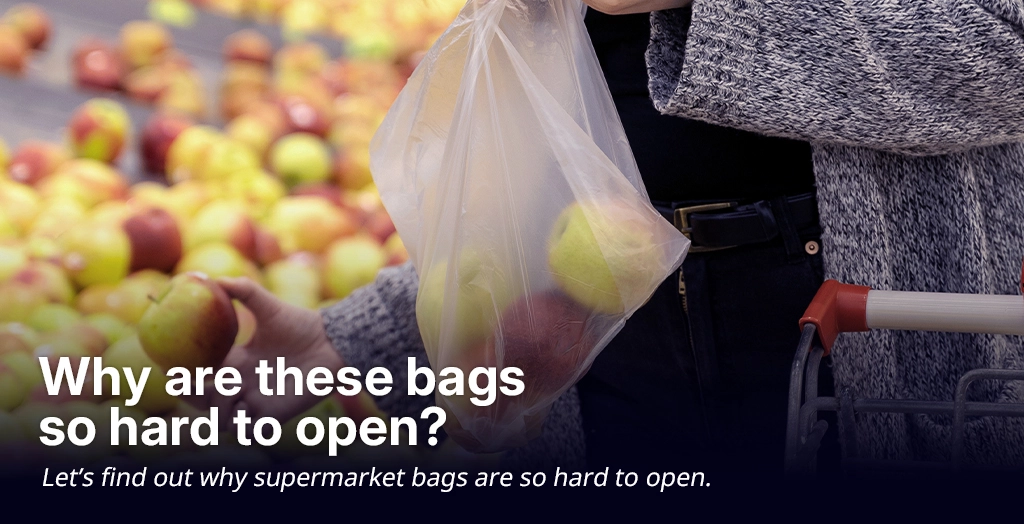
We’ve all been there. You tear a bag off the roll, try to pull the opening apart, rub it between your fingers, blow into it — and it still refuses to open. The two sides cling together like they were sealed shut on purpose.
So what’s actually going on? And why does it seem so much easier to open them in some stores than others?
It turns out this has very little to do with bag quality — and a lot to do with physics.
It Starts with How Thin the Film Actually Is
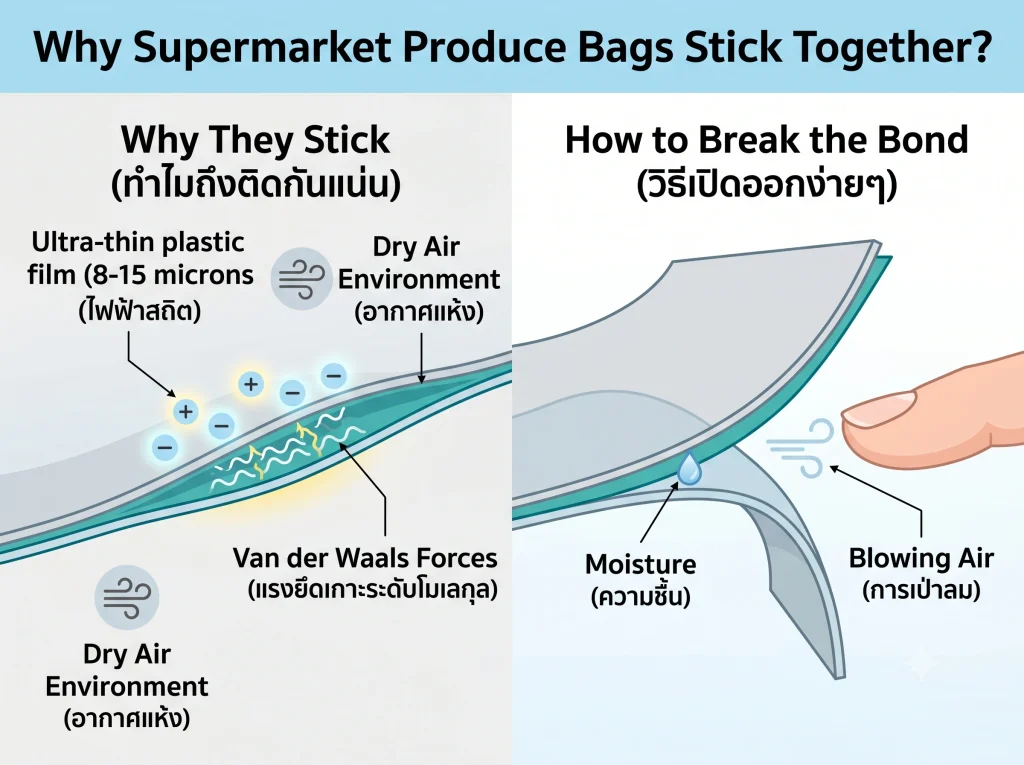
Most produce bags in supermarkets are made from LLDPE or LDPE film at a thickness of just 8 to 15 microns. For context, a human hair is roughly 70 microns thick. At that level of thinness, the film is incredibly smooth and flexible — which is exactly what makes it behave the way it does.
When hundreds of these ultra-thin bags are rolled together under pressure, the surfaces of adjacent layers come so close to each other that molecular-level forces kick in. These are called Van der Waals forces — weak attractions between molecules that individually don’t amount to much, but across a large surface area add up to a surprisingly strong grip. The result is what engineers call film blocking: the layers effectively cling to each other without any adhesive at all.
On top of that, PE film is an electrical insulator. Friction from rolling, handling, and dry air causes static charge to build up on the surface — and that static pulls the two sides of the bag even closer together. The drier the air and the drier your hands, the worse it gets.
Why Don’t Manufacturers Just Fix This?
They do try — but it’s a balancing act.
During production, manufacturers add slip agents and anti-blocking agents to the film formulation to reduce surface adhesion. The problem is that if you add too much, the bags become so slippery that they separate on their own while still on the roll, making it impossible to dispense one bag at a time. Too little, and you end up with the frustrating cling we all know.
The goal is to land right in the middle: bags that stay together until you want them open, but release cleanly when you do. That balance is harder to achieve than it sounds, and the exact formulation varies from one manufacturer to another — which is part of why bags that look identical can feel completely different in use.
Why Is It Easier in Some Stores Than Others?
This is where it gets interesting — because the bag itself often isn’t the variable. The environment around it is.
In stores with heavy air conditioning running all day, the air gets very dry. Dry air increases static buildup on the film surface, making the layers cling harder. In contrast, the produce section in many supermarkets is regularly misted with water — and that small amount of humidity in the air is enough to dissipate static and let air slip between the film layers. Same bag, completely different experience.
Age matters too. A fresh roll that just arrived from the warehouse opens much more easily than one that has been hanging in the store for weeks or months. The longer the bags sit under their own rolled tension, the more the surfaces press together and the stronger the molecular adhesion becomes. Over time, even the small air gaps between layers disappear.
The tension used when rolling the bags at the factory also plays a role. Tightly wound rolls press the layers together from the start. By the time the roll reaches the store, that compression has been building for days or weeks.
And there’s one more factor most people never think about: every time a customer pulls a bag off the roll, the friction generates a little more static charge — which makes the next bag slightly harder to open than the one before it.
So Why Does Rubbing Your Fingers or Blowing Into the Bag Actually Work?
Because you’re doing exactly what the physics requires. Moisture on your fingertips and air blown into the opening both introduce a thin layer between the film surfaces — breaking the contact area, reducing the Van der Waals adhesion, and giving the bag somewhere to expand into. You’re not fighting the bag. You’re working with the same principles the film was designed around.
The Bag Hasn’t Changed — Everything Around It Has
Next time you struggle with a produce bag, it’s worth knowing you’re not dealing with a defective product. You’re experiencing the combined effect of film thickness, molecular surface forces, static electricity, air humidity, roll age, storage conditions, and manufacturing formulation — all converging in one small frustrating moment at the fruit aisle.
The bag is doing exactly what it was designed to do. The world around it just isn’t always cooperating.
FAQ
Q: Are hard-to-open produce bags a sign of poor quality?
A: Not at all. The clinginess is a natural result of ultra-thin film physics — specifically molecular adhesion and static buildup — not a manufacturing defect.
Q: What type of plastic are produce bags made from?
A: Most are made from LLDPE or LDPE film, typically between 8 and 15 microns thick — far thinner than a human hair.
Q: What causes the bags to stick together?
A: Two main forces: Van der Waals molecular attraction between the smooth film surfaces, and electrostatic charge that builds up from friction during rolling and handling.
Q: Why is it easier to open bags in the fresh produce section than elsewhere in the store?
A: Produce sections are often misted with water, which raises humidity slightly. That moisture reduces static charge on the film and helps air slip between the layers — making bags noticeably easier to open.
Q: Why do older rolls seem harder to open than new ones?
A: Over time, the pressure from the rolled layers presses the film surfaces closer and closer together, eliminating air gaps and increasing adhesion. Fresh rolls haven’t had time to compress like that yet.
Q: Does the manufacturing formula affect how easy a bag is to open?
A:Yes significantly. Manufacturers use slip agents, anti-blocking agents, and antistatic additives to control surface behaviour — and the exact balance of these varies by supplier. Two bags of identical thickness can feel very different to open depending on the formulation.
Q: What’s the best way to open a stubborn produce bag?
A: Lightly moisten your fingertips or blow air directly into the opening. Both methods introduce a thin layer between the film surfaces, breaking the adhesion and giving the bag room to open.