
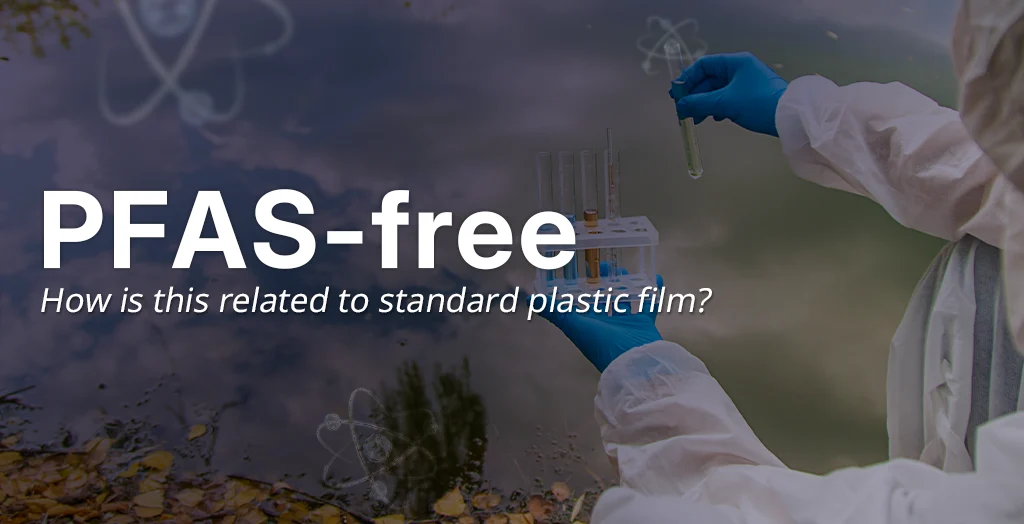
If you work in packaging, chances are you’ve received this email: one line, no context, just — “Can you confirm your products are PFAS-free?”
It comes from buyers in the EU, the US, Australia, and a growing list of markets where chemical safety standards are tightening fast — especially around food-contact materials and general packaging. And while the question sounds simple, the honest answer is anything but.
Why “PFAS-Free” Isn’t a Yes-or-No Question
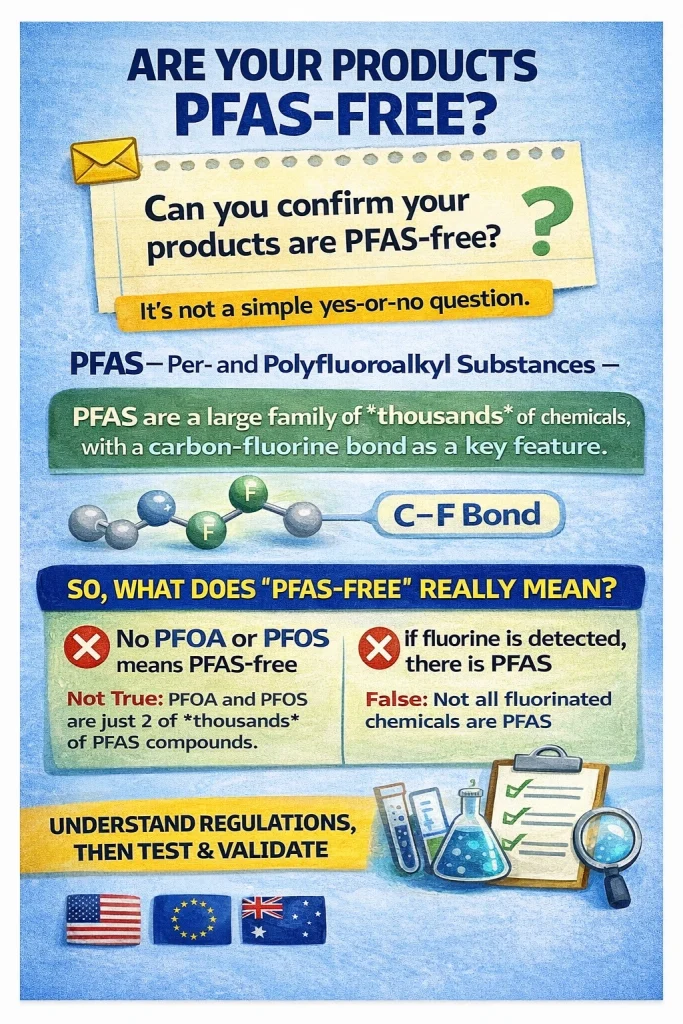
PFAS — Per- and Polyfluoroalkyl Substances — isn’t one chemical. It’s a family of thousands of compounds, all sharing a carbon-fluorine (C–F) bond as their defining feature. Some countries regulate specific PFAS individually. Others are moving toward regulating the entire class at once. Under REACH, for example, certain PFAS are already restricted, and the regulatory landscape is still evolving.
So before anyone can answer “PFAS-free,” the real question is: which definition of PFAS are we working with, and which regulation is this customer actually referring to?
Without that clarity, even a well-intentioned answer can miss the mark entirely.
Two Common Misconceptions Worth Clearing Up
A lot of confusion in this space comes down to two assumptions that sound reasonable but aren’t quite right.
“No PFOA or PFOS detected means PFAS-free.” Not quite. PFOA and PFOS are among the most well-known PFAS compounds, but they’re just two members of a family that numbers in the thousands. Targeted testing only confirms the absence of whatever substances were specifically tested for — it says nothing about the rest of the group.
“If fluorine is detected, there must be PFAS.” Also not accurate. Fluorinated compounds and PFAS are not the same thing. Many chemicals contain fluorine without being classified as PFAS. Interpreting test results correctly requires understanding both the chemical structure and the regulatory context behind the test.
Where Does Plastic Film Fit In?
For plastic films made from standard resins — PE being a common example — PFAS aren’t typically required in the formulation at all. That’s the good news.
But here’s the thing: the question customers are really asking isn’t “do you use PFAS?” It’s “can you prove you don’t?” Those are very different things.
What actually builds credibility isn’t a single test certificate — it’s the system behind it. That means sourcing raw materials from verified, standards-compliant suppliers; maintaining documented formulation controls; conducting regular risk assessments; and running testing when specific requirements demand it.
Testing Helps, But Systems Are What Matter
A lab report can confirm a result at a point in time. What creates lasting trust — with customers, auditors, and regulators — is a continuously operating control system.
That includes traceable supplier declarations, a process for monitoring regulatory changes as they happen, and documentation that’s ready when anyone asks to see it. In other words: not just the answer, but the infrastructure that makes the answer reliable.
What the Question Is Really Asking
“Can you confirm your products are PFAS-free?”
Beneath the one-line email, what customers are actually asking is: “Does your production system have the standards and processes in place to support increasingly rigorous safety requirements?”
It’s a question that doesn’t end with one test result. It reflects an entire approach — from how raw materials are selected, to how risks are assessed, to how your team stays current as regulations continue to change.
That’s the answer worth building. And it’s worth far more than a simple yes.
FAQ
Q: Does “no PFOA/PFOS detected” mean a product is PFAS-free?
A: No. PFOA and PFOS are just two of thousands of PFAS compounds. A targeted test only confirms the absence of the specific substances it was designed to detect.
Q: If a product contains fluorine, does that mean it contains PFAS?
A: Not necessarily. Fluorinated compounds and PFAS are not the same thing. Fluorine can be present in many chemicals that don’t fall under the PFAS classification.
Q: Do standard plastic films like PE contain PFAS?
A: Typically no — PFAS aren’t required in standard PE film formulations. However, the more important question is whether there’s a verified system in place to consistently confirm this.
Q: What should I ask for instead of just a test certificate?
A: Ask for supplier declarations, formulation controls, and documentation showing how the manufacturer monitors regulatory changes. A single test result is a snapshot; a control system is ongoing assurance.
Q: Which regulations should I reference when asking about PFAS compliance?
A: It depends on your market. EU buyers often reference REACH restrictions; US buyers may reference EPA guidelines or state-level rules (e.g., California). Always specify which regulation or standard you’re asking about to get a meaningful answer.
Q: How often do PFAS regulations change?
A: Frequently. The regulatory landscape is still evolving in most major markets. Suppliers should have a process for actively monitoring updates — not just responding after the fact.