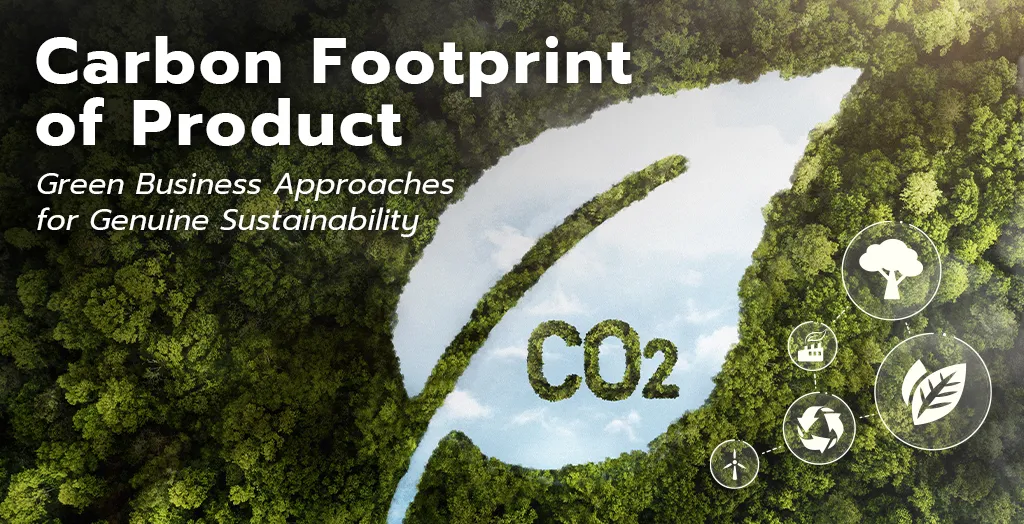
What Is the Carbon Footprint of Product (CFP)?
The Carbon Footprint of Product (CFP) measures the total amount of greenhouse gas (GHG) emissions released throughout a product’s entire life cycle — from sourcing raw materials, manufacturing, transportation, and usage, to end-of-life disposal.
The result is expressed in kilograms of carbon dioxide equivalent (kgCO₂e), a standard unit that represents the overall climate impact of a product.
When calculating CFP, all major greenhouse gases are included — such as carbon dioxide (CO₂), methane (CH₄), and nitrous oxide (N₂O) — as well as other gases defined by international standards, including HFCs, PFCs, SF₆, and NF₃.
All calculations follow the globally recognized ISO 14067 standard.
Key Features of CFP Assessment
- Covers the entire life cycle of a product — from raw material extraction to disposal.
- Expressed in kgCO₂e per unit of product, e.g., per kilogram or per liter.
- Helps organizations identify and reduce GHG emissions throughout their production processes.
- Supports corporate sustainability goals and environmentally responsible business practices.
CFP Types: B2B vs. B2C
| Aspect | CFP: B2B (Business-to-Business) | CFP: B2C (Business-to-Consumer) |
|---|---|---|
| Assessment Scope | Measures emissions from raw material acquisition to the factory gate (Cradle-to-Gate). Does not include product use or disposal. | Covers the entire product life cycle from raw materials, production, distribution, usage, and end-of-life management (Cradle-to-Grave). |
| Product Type | Typically raw materials or components used to manufacture other products. | Finished goods delivered directly to end consumers. |
| Use of CFP Data | No CFP label on packaging, but provides CO₂ emission data to business clients for use in their own production footprint. | CFP label may appear on packaging (optional, depending on the manufacturer). |
| Examples | Plastic resin pellets, water bottle preforms, corrugated paper. | Packaged disposable gloves, bottled water, household appliances. |
Why CFP Matters
Conducting a CFP assessment is a crucial step toward developing environmentally responsible products. It helps reduce climate impact and aligns with the growing demand for sustainable consumption in global markets.
Both CFO (Carbon Footprint of Organization) and CFP (Carbon Footprint of Product) use the same measurement unit — carbon dioxide equivalent (CO₂e). This ensures consistency when evaluating total greenhouse gas emissions across different sources and activities.
The Connection Between CFP and CFO
While CFO focuses on assessing an organization’s total greenhouse gas emissions, CFP zooms in on each individual product.
By combining both, a company gains a complete picture of its environmental impact — from operations to products.
When performed regularly, CFP and CFO assessments help organizations set realistic emission reduction targets, track progress, and demonstrate their commitment to sustainability.
In Summary
Assessing a product’s carbon footprint (CFP) is more than just data collection — it’s a strategic move toward climate responsibility and long-term sustainability.
It helps organizations:
- Understand and minimize their environmental impact,
- Enhance brand credibility, and
- Build stronger trust with customers and partners.
Businesses that start measuring their Carbon Footprint of Product today are not only preparing for a sustainable future — they’re already one step ahead.