Packaging used to be simple. Protect the product, look good on the shelf, keep costs down. But if you’re selling into the EU — or planning to — that definition no longer covers it.
Today, packaging is evaluated on an entirely different set of criteria: can it actually be recycled? Does it use more material than necessary? What happens to it after the consumer is done with it? These aren’t just sustainability talking points anymore. They’re regulatory requirements — and they’re coming with hard deadlines.
That’s the reality of PPWR.
What Is PPWR?
PPWR — the Packaging and Packaging Waste Regulation — is EU legislation that governs packaging across its entire lifecycle, from design and production through to end-of-life management. Its core objective is to align all packaging sold in the EU with the principles of the Circular Economy: less waste, more reuse, and materials that can actually re-enter the system rather than ending up in landfill.
It replaces the older Packaging and Packaging Waste Directive and sets a single, harmonised standard across all EU member states.
Why Does It Matter — and Why Now?
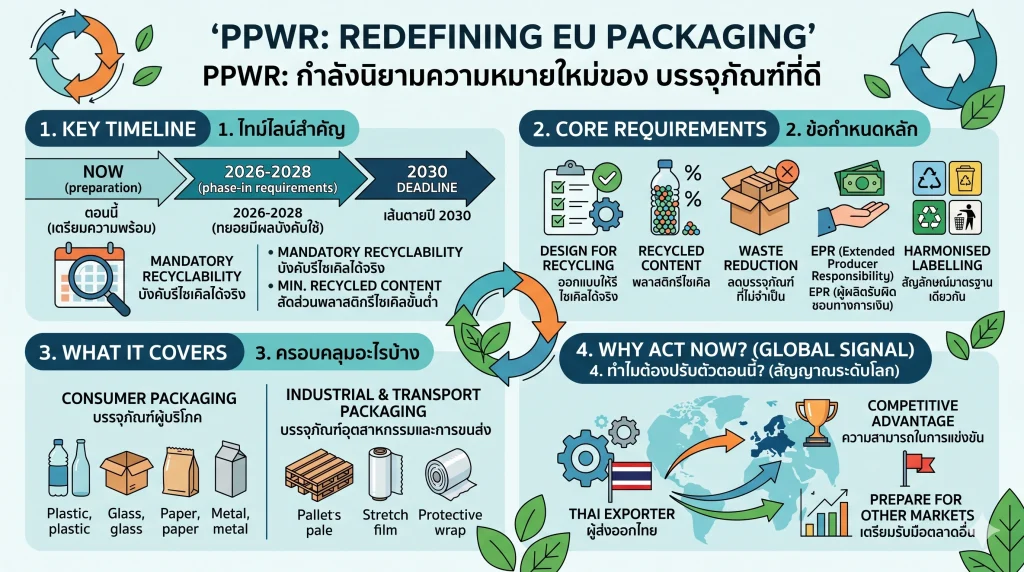
PPWR isn’t a vague long-term ambition. It has a concrete timeline. Several key requirements are set to phase in between 2026 and 2030, including mandatory recyclability standards for all packaging by 2030 and minimum recycled content requirements for certain plastic packaging types.
That window is shorter than it sounds. Businesses that wait until the requirements are fully in force will have very little time to redesign, requalify, and recertify their packaging. The transition period exists precisely so manufacturers, importers, and exporters — including those based outside the EU, such as Thai suppliers — can prepare now rather than scramble later.
There’s also a broader signal worth paying attention to: PPWR is increasingly being seen as a regulatory model. Other markets are watching. Getting ahead of it isn’t just about EU compliance — it’s about positioning for where global standards are heading.
What Does PPWR Actually Require?
At its core, PPWR asks one question of every piece of packaging sold in the EU: what happens to this after it’s used?
The regulation addresses this through several interconnected requirements. Design for Recycling means packaging must be designed to be genuinely recyclable within defined timeframes — not theoretically recyclable in ideal conditions, but practically recyclable within real collection and sorting systems. Recycled Content mandates minimum percentages of recycled plastic in new packaging for certain categories. Waste Reduction targets unnecessary packaging — oversized boxes, excessive layers, materials that serve no functional purpose. Extended Producer Responsibility (EPR) means producers must take financial responsibility for the end-of-life management of their packaging. And Harmonised Labelling introduces standardised symbols across the EU so consumers can sort waste correctly regardless of which country they’re in.
What Does PPWR Cover?
Everything. All packaging materials, all packaging types, sold at any scale in the EU market.
That includes consumer-facing packaging — boxes, bottles, pouches, cartons in plastic, glass, paper, and metal — as well as industrial and transport packaging like wooden pallets, stretch film, and protective wrapping. Food-contact packaging has additional substance restriction requirements layered on top.
If it wraps, contains, or protects a product sold in Europe, PPWR applies to it.
The Bottom Line
PPWR is a clear signal that packaging standards are changing — fundamentally, not incrementally. The EU is moving toward a full circular economy model, and packaging is one of the primary levers to get there.
For businesses involved in manufacturing and export, this isn’t just a compliance exercise. It’s a competitive one. The companies that understand what’s required, start adapting their materials and designs now, and build traceability into their supply chains will be the ones with continued access to one of the world’s largest consumer markets.
The question isn’t whether to adapt. It’s how soon.
FAQ
Q: What does PPWR stand for and when does it apply?
A: PPWR stands for Packaging and Packaging Waste Regulation. Key requirements phase in between 2026 and 2030, with full recyclability standards for all packaging required by 2030.
Q: Who does PPWR affect?
A: Anyone who places packaged products on the EU market — including manufacturers, importers, and exporters based outside the EU, such as suppliers in Thailand or other Asian markets.
Q: Does PPWR apply to industrial packaging, or just consumer packaging?
A: Both. It covers all packaging types and materials, including stretch film, pallets, and protective wrapping used in B2B and transport contexts.
Q: What is “Design for Recycling” under PPWR?
A: It means packaging must be designed so it can actually be recycled within real-world collection and sorting systems — not just in theory. Packaging that can’t meet this standard won’t be permitted on the EU market after the deadline.
Q: What are the recycled content requirements?
A: PPWR sets minimum percentages of recycled plastic that must be incorporated into certain new plastic packaging types. The exact thresholds vary by packaging category and phase-in timeline.
Q: What is EPR and how does it affect my business?
A: Extended Producer Responsibility means producers are financially responsible for managing their packaging after consumers are done with it. This often translates into fees paid into national EPR schemes in each EU country where products are sold.
Q: Is PPWR only relevant for the EU market?
A: For now, it’s an EU regulation. But it’s widely regarded as a model others may follow. Preparing for PPWR puts businesses in a stronger position as similar frameworks emerge in other markets.