Have you ever wondered why certain chemicals that were once used everywhere — in factories, farms, and everyday products — are now banned in almost every country? Not because they stopped working, but because they never really went away.
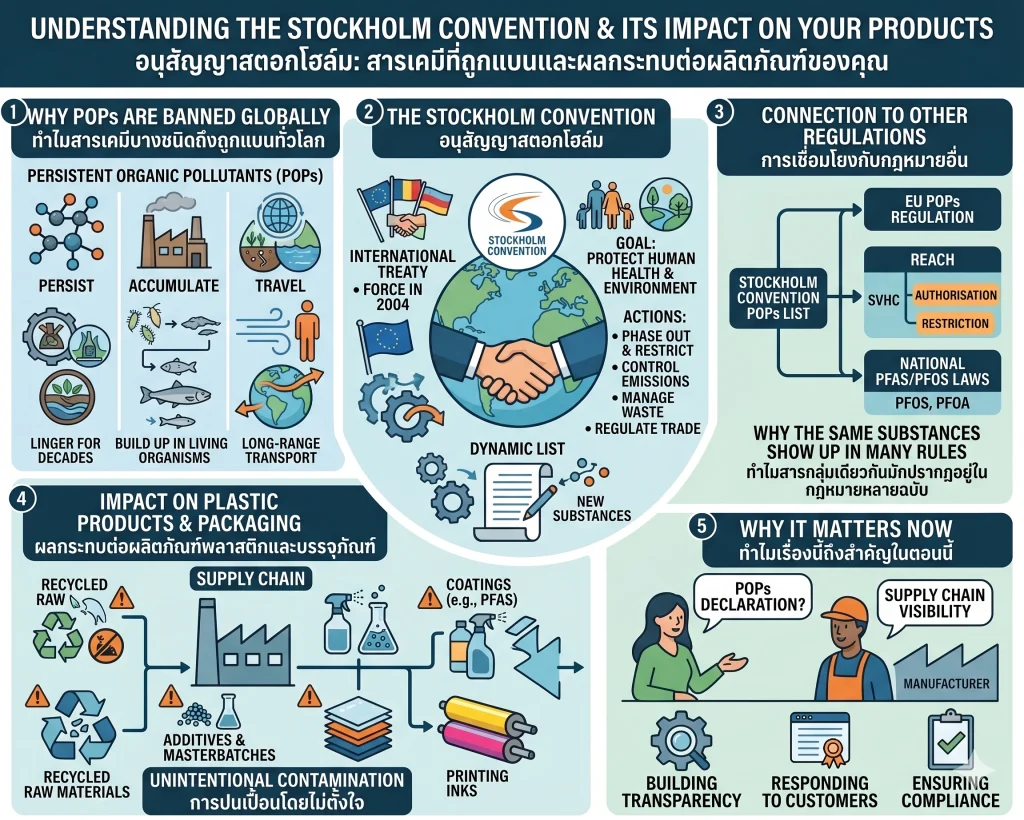
These substances don’t break down. They linger in soil and water for decades, accumulate in animals, and eventually make their way back into the human body — long after the original source has disappeared. That’s a problem no single country can solve alone.
That’s exactly why the Stockholm Convention exists.
What Is the Stockholm Convention?
The Stockholm Convention on Persistent Organic Pollutants (POPs) is an international treaty that came into force in 2004. Its goal is straightforward: protect human health and the environment from a specific class of dangerous chemicals known as POPs — substances that persist, travel, and accumulate in ways that make them uniquely harmful over time.
Under the Convention, member countries commit to reducing, restricting, and ultimately eliminating the production, use, import, export, and release of these substances.
What Does It Actually Do?
The Convention works across several fronts. Member countries agree to phase out or restrict listed POPs, control unintentional releases from industrial processes, safely manage POPs-containing waste, and regulate cross-border trade in these substances under strict conditions.
Critically, the list isn’t static. It’s updated continuously as new scientific evidence emerges — meaning a substance considered safe today could be listed tomorrow. Each member country is also required to develop a National Implementation Plan (NIP) to show how they’ll put these commitments into practice.
How Does It Connect to Other Regulations?
This is where it gets directly relevant for businesses. When a substance is listed as a POP under the Stockholm Convention, member countries are required to reflect that in their own national laws. That’s why the same substances tend to show up across multiple regulatory frameworks:
The EU POPs Regulation directly incorporates Stockholm Convention requirements, prohibiting or restricting listed substances in products and waste streams. REACH adds another layer of control, treating many POPs as substances requiring authorisation or restriction. Some POPs also qualify as SVHCs (Substances of Very High Concern) due to their persistence and toxicity. And many of the national PFAS and PFOS laws you see today trace their origins back to the Stockholm Convention — PFOS and PFOA were added to the POPs list, triggering a wave of national legislation that followed.
Understanding the Stockholm Convention, in other words, gives you the context to make sense of the broader regulatory landscape.
What Does This Have to Do with Plastic Products and Packaging?
More than many manufacturers expect.
Plastic products can come into contact with POPs unintentionally at multiple points in the supply chain — not because anyone made a conscious choice to use them, but because contamination can enter through recycled raw materials with residues from previous uses, certain additives and masterbatches, water- or oil-resistant coatings linked to PFAS, printing inks and surface treatments, and multi-tier supply chains where visibility is limited.
The factory itself may have no intention of using these substances. But without active controls at each stage of the supply chain, the risk remains.
Why This Matters Now
The Stockholm Convention might look like a piece of international environmental policy — and it is. But in practice, it’s one of the key reasons why customers around the world are becoming more rigorous about chemical controls in the products they source.
When a buyer asks for documentation on restricted substances, or requests a supplier declaration covering POPs, they’re often tracing a requirement that started here. Knowing where these rules come from makes it much easier to respond to them — and to build the kind of supply chain transparency that today’s market increasingly demands.
FAQ
Q: What does “POPs” actually mean?
A: POPs stands for Persistent Organic Pollutants — chemicals that don’t break down easily, travel long distances through air and water, and accumulate in living organisms over time.
Q: When did the Stockholm Convention come into force?
A: It has been in effect since 2004 and currently has over 180 member countries.
Q: Is Thailand a member of the Stockholm Convention?
A: Yes. Thailand is a signatory and is required to develop and implement a National Implementation Plan (NIP) in line with the Convention’s obligations.
Q: How does this affect my business if I manufacture plastic packaging?
A: Even if you don’t intentionally use POPs, contamination can enter your supply chain through recycled materials, additives, coatings, or inks. Having documented controls and traceable supplier declarations is increasingly expected by global buyers.
Q: Are PFAS and POPs the same thing?
A: Not exactly. POPs is the broader category. Some PFAS — specifically PFOS and PFOA — have been listed as POPs under the Stockholm Convention, which is what triggered much of the national PFAS legislation we see today.
Q: How do I know if a substance I use is listed under the Stockholm Convention?
A: The full and updated list of controlled substances is published on the official Stockholm Convention website. Your chemical suppliers and compliance team should be monitoring this list regularly.
Q: Does the Stockholm Convention directly restrict products, or just chemicals?
A: Primarily chemicals — but since member countries translate Convention obligations into national law (like the EU POPs Regulation), those restrictions do end up applying to products and materials in those markets.