
When the World Demands Change
Nowadays, plastic waste has become a critical global issue. As a leading Thai manufacturer of plastic gloves, plastic bags, and plastic film products, Bags and Gloves Co., Ltd. addresses this challenge through serious commitment to environmentally friendly innovation.
One of our proudest innovations is our range of Biodegradable & Compostable Products—materials that break down naturally and carry internationally recognized certifications.
Bio-Compostable Plastics – Not Greenwashing, But a Real Future
Our biodegradable products are engineered to decompose in biological environments such as compost facilities or soil, leaving behind no toxic residues or harmful materials that could damage nature.
Products We Actually Develop and Manufacture
- Bio-Compostable Gloves – Gloves that genuinely decompose in natural environments
- Compostable Plastic Bags – Suitable for everyday use
- Compostable Garbage Bags – Helping reduce long-term plastic waste challenges
- Other plastic film products certified for biodegradability
Bio-Compostable Gloves – Plastics That Give Life Back to Nature
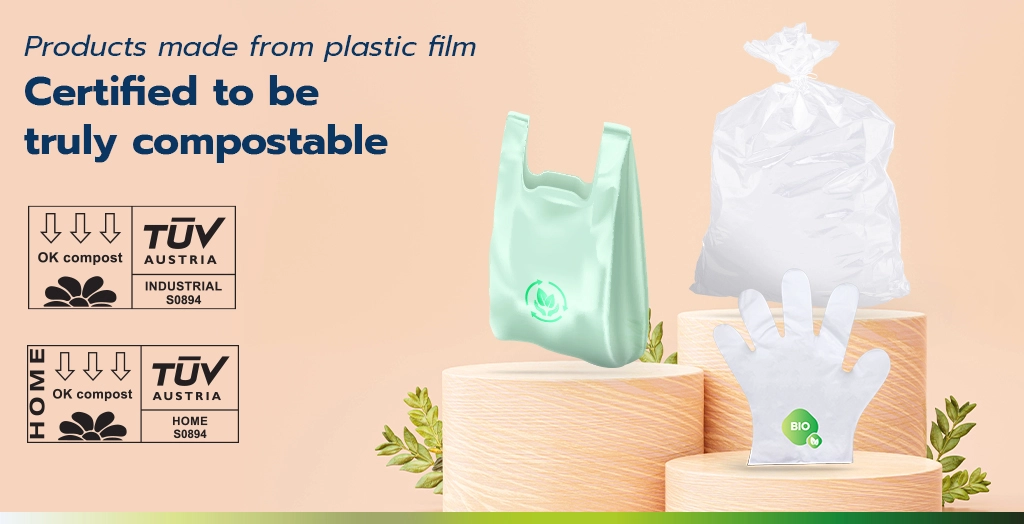
Our bio-compostable gloves are made from raw materials certified by leading global organizations such as TÜV Austria. This certification confirms that when disposed of properly in compost facilities, these gloves break down into organic matter that actively improves soil quality.
Bio-Based Material Pellets
We also develop gloves from bio-based plastic pellets derived from plants, including:
- Sugarcane
- Corn
- Cassava
These raw materials are renewable resources that require significantly less energy to produce compared to petroleum-based plastics, resulting in measurable carbon emission reductions during manufacturing.
Verifiable International Standards
To ensure consumer confidence that our products don’t just claim to be biodegradable but actually are, we use raw materials tested and certified according to international standards:
- OK Compost Industrial from TÜV Austria – Certification confirming products can decompose in industrial composting systems
- DIN CERTCO Certification – Internationally recognized certification from Germany
Moving Toward Sustainable Manufacturing
Our biodegradable products represent our dedication to discovering and producing innovative solutions. They’re also part of our business approach focused on “Sustainable Manufacturing”—consideration for consumers, the environment, and the planet’s long-term future.
Truly Biodegradable, Because Our Planet Deserves Care
We firmly believe that every product we manufacture must not only meet quality standards but also “restore balance to the planet.” Our biodegradable products serve as clear evidence of our environmental and social responsibility. This is what we’re doing every day—not just words, but real products you can touch and use.