Have you ever wondered why exporting to Europe involves so much more red tape than other markets? The answer is REACH — the world’s most comprehensive and stringent chemical regulation. It covers nearly everything you can touch, from textiles and electronics to furniture and packaging — even products that don’t seem chemical-related at all.
If your business exports to the European Union, or you’re planning to expand there, understanding REACH isn’t optional — it’s essential. Failure to comply can result in your products being detained at customs, hefty fines, or even being permanently banned from the EU market.
What Is REACH? (And Why the Long Name?)
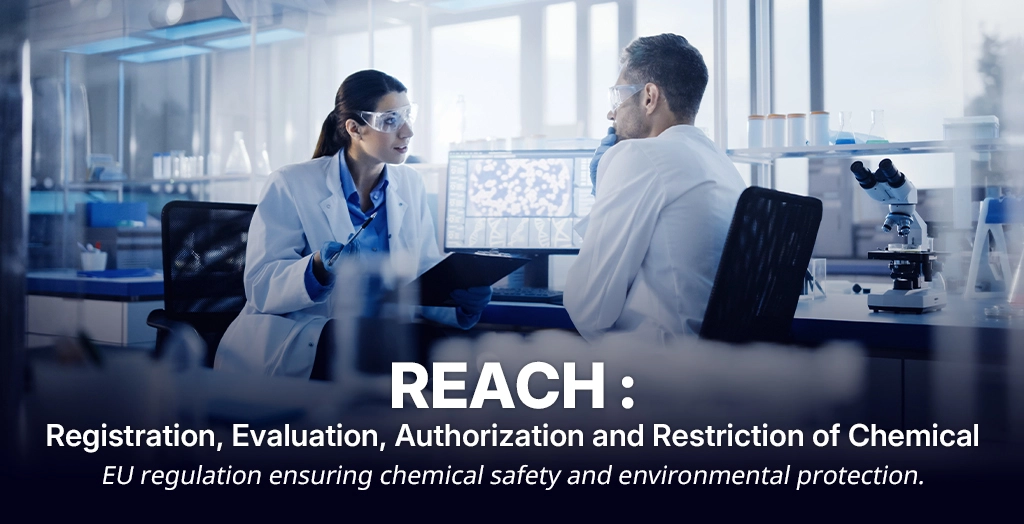
REACH stands for Registration, Evaluation, Authorization, and Restriction of Chemicals. The name itself reflects the scope of this regulation — it’s not just a single requirement, but a comprehensive system.
Enacted in 2007 (Regulation (EC) No. 1907/2006), REACH is the European Union’s central chemical regulation. It’s built on a simple but powerful principle: “No chemical should be used without proof of safety.”
This means the burden of proof has shifted to manufacturers and importers — not regulators. You must prove your chemicals are safe before you can sell your products in the EU market.
Why Should Non-EU Companies Care About REACH?
You might think, “We’re not based in Europe, why does this matter?” Here’s why:
- The EU is a massive market: With over 450 million consumers and one of the world’s largest import markets.
- REACH doesn’t discriminate: If you want to sell in the EU, you must comply — no exceptions for non-EU companies.
- Financial and reputational impact: Non-compliance can lead to product detention, heavy fines, or blacklisting.
- European buyers demand assurance: EU customers scrutinize suppliers and want partners who understand and comply with REACH.
The Four Pillars of REACH: How It Works
REACH operates through four interconnected pillars. Each plays a specific role in protecting health and the environment:
1. Registration: “No Data, No Market”
This is the heart of REACH. If you manufacture or import a chemical substance into the EU at more than 1 ton per year, you must register it with ECHA (European Chemicals Agency). Registration requires submitting data on:
- Chemical properties (chemistry, physics, toxicology)
- Safe use guidelines
- Risk management measures
Important: The higher the volume, the more detailed the data required — and the higher the cost. Registration for 1 ton/year might start at tens of thousands of euros, while substances over 1,000 tons/year can exceed hundreds of thousands.
2. Evaluation: Scrutinizing the Data
After registration, ECHA and EU member states evaluate whether the submitted data is reliable and sufficient. If deficiencies are found, you may be asked to provide additional data or conduct new tests.
3. Authorization: High-Concern Substances
Certain substances with very high risks — such as carcinogens, mutagens, and endocrine disruptors — are placed on the Candidate List and may be moved to Annex XIV (Authorization List). This means:
- Automatic prohibition unless specifically authorized
- You must prove “no safer alternative exists” or “benefits outweigh risks”
Pro tip: If your products contain SVHC (Substances of Very High Concern), start looking for substitutes immediately — don’t wait until it’s mandated.
4. Restriction: The Red Line You Cannot Cross
When a substance is proven unacceptably dangerous, it may be added to Annex XVII — the restriction list. This means the substance may be completely banned, or subject to strict conditions such as concentration limits, use restrictions in certain products, or special warning labels.
What Products Does REACH Cover?
Short answer: Almost everything.
REACH covers three main categories:
- Substances: Pure chemicals like sodium hydroxide or formaldehyde
- Mixtures: Paints, adhesives, cleaning products, cosmetics, printing inks
- Articles: Finished products like clothing, shoes, furniture, electronics, toys
Surprising examples:
- A simple cotton t-shirt with dyes or chemical residues → May require SVHC reporting
- Plastic furniture with flame retardants → Must check if substances are on the Candidate List
- Paper packaging coated with plastic → Must assess coating chemicals
REACH Exemptions: What’s Not Covered?
While REACH is broad, certain categories are exempt because they’re already regulated by specific laws:
- Full exemptions: Radioactive substances, waste, goods in customs transit, transport of dangerous goods, intermediates formed during manufacturing
- Partial exemptions: Food, pharmaceuticals, animal feed — exempt from registration but must comply with other conditions
REACH for Non-EU Exporters: Your Action Plan
If you manufacture or export products to the EU, here’s what you need to do:
1. Appoint an Only Representative (OR)
Non-EU companies cannot register directly with ECHA. You must hire an Only Representative with an office in the EU to register on your behalf. This intermediary acts as your legal representative before ECHA.
2. Prepare Safety Data Sheets (SDS)
The SDS is your chemical’s “passport.” It contains everything about the substance: hazards, safe use, storage, and first aid. EU customers require SDS as proof of compliance.
3. Monitor SVHC Regularly
The Candidate List of SVHC (Substances of Very High Concern) is updated annually. If your products contain SVHC above 0.1% by weight, you must notify ECHA and inform customers.
4. Work Closely with Your Importer
Without an OR, the EU importer becomes responsible for registration. You must provide complete and accurate data to support them — otherwise, they may refuse to import your products.
Costs and Challenges: What to Expect
REACH compliance isn’t easy, and there are real costs in both money and time:
- Registration fees: Depend on substance volume — from tens of thousands to hundreds of thousands of euros
- Testing costs: Toxicological and environmental testing can be very expensive
- Only Representative fees: Typically annual fees plus initial service charges
- Penalties: Non-compliance can result in heavy fines and product detention
Benefits Beyond Compliance
Despite the complexity, REACH compliance offers clear advantages:
- Access to a major market: The EU has over 450 million consumers willing to pay premium prices for safe products
- Build credibility: REACH compliance demonstrates your commitment to safety and quality
- Drive green innovation: Encourages development of safer, environmentally friendly alternatives
- Reduce long-term risk: Prevents future legal issues and reputational damage
Bottom Line: REACH Is an Opportunity, Not Just a Burden
REACH may seem complex and intimidating at first, but look deeper — it’s an opportunity to prove your products are safe, high-quality, and ready for the world’s most demanding market.
The sooner you understand and start the process, the better your chances of success in the EU market. Don’t see it as an obstacle — see it as the standard that will elevate your business to a global level.
Frequently Asked Questions
Q: If my product isn’t a chemical, do I need to worry about REACH?
A: Yes. Even products like clothing, shoes, or furniture may contain reportable chemicals such as dyes, plasticizers, or flame retardants.
Q: What’s the difference between an Only Representative and an Importer?
A: An Only Representative is hired by a non-EU company to register on their behalf. An Importer is the EU-based entity receiving the goods. Without an OR, the registration burden falls on the Importer.
Q: What is the Candidate List?
A: It’s a list of Substances of Very High Concern (SVHC) that may eventually be moved to the Authorization List. If your product contains SVHC above 0.1%, you must notify ECHA and inform customers.
Q: How much does REACH compliance cost?
A: It depends on substance volume and type — ranging from tens of thousands to hundreds of thousands of euros, including registration, testing, and OR fees. But it’s worth it for EU market access.