As organizations race to develop Low Carbon Products, the most critical question in the boardroom isn’t “How do we reduce carbon?” but rather, “Where should we reduce it to make a real, measurable impact?”
In reality, carbon emissions are scattered across a product’s entire lifespan. Trying to cut carbon everywhere at once without a clear data strategy is a recipe for wasted budgets and minimal environmental return.
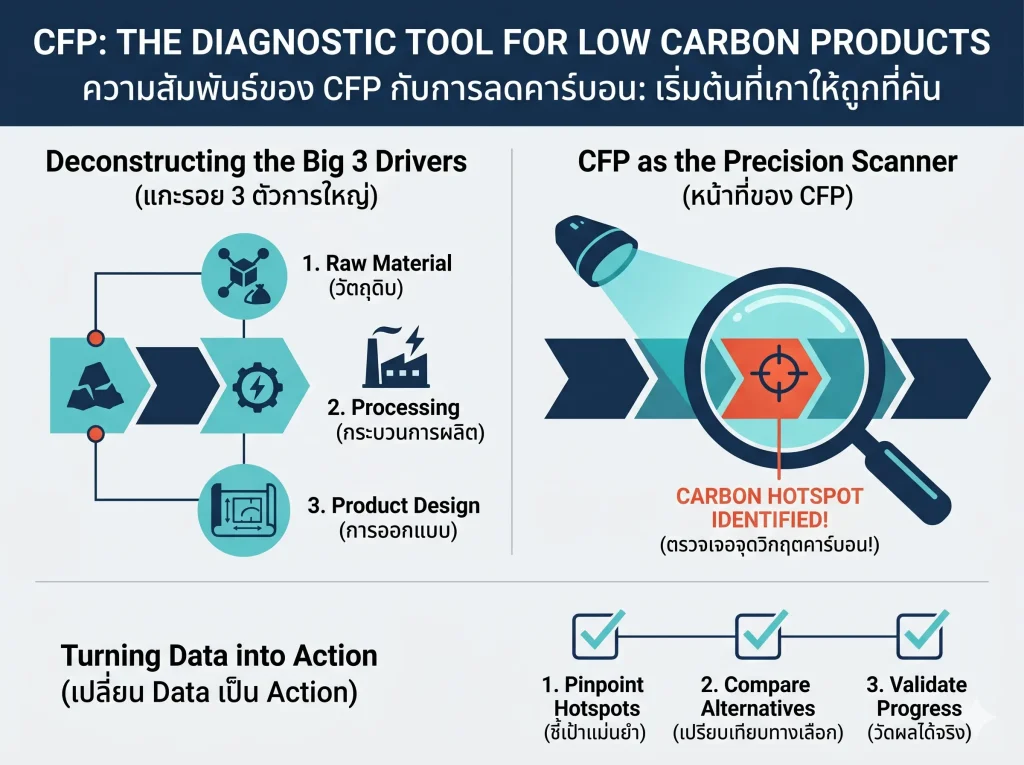
Deconstructing the “Big 3” Carbon Drivers in Products
If you look at any single product, carbon emissions generally stem from three core areas:
- Raw Materials: The origin, extraction, and initial processing of the ingredients.
- Processing & Manufacturing: The electricity, thermal energy, and resources consumed on the factory floor.
- Product Design: The dimensions, shape, weight, and functionality—which dictate how much material is required and how difficult it will be to recycle.
The Takeaway: While shifting to bio-based “Materials” gets a lot of hype, “Design” and “Process” often play an equally massive—if not larger—role in a product’s carbon profile. Because every product is different, the emission proportions vary significantly.
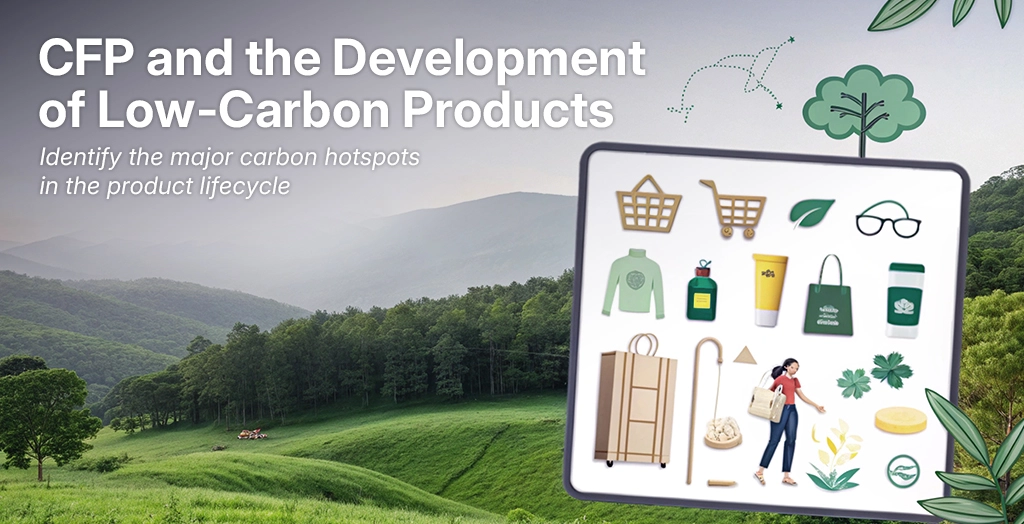
Hunting for the “Hotspots”: Enter the Role of CFP
How can an organization pinpoint exactly which stage of their product’s life cycle is the heaviest polluter?
This is where CFP (Carbon Footprint of Product) comes into play. Think of CFP as a high-precision scanner—a diagnostic tool that maps out and quantifies greenhouse gas emissions across the product’s entire life cycle, from cradle to grave.
Moving Beyond Compliance: Making CFP an Actionable Tool
An effective CFP is much more than a compliance report or a certificate to display on your website; it is a strategic decision-making engine that allows you to:
- Identify Hotspots: Pinpoint the exact manufacturing or supply chain node responsible for the highest emissions.
- Evaluate Alternatives: Compare data-driven scenarios (e.g., traditional materials vs. green alternatives, or energy optimization setups) before capital injection.
- Validate Progress: Accurately measure and prove to stakeholders that your carbon reduction initiatives actually worked.
Turning CFP Insights into Real Business Value
Developing a Low Carbon Product without CFP is like navigating a new city without a map.
True sustainability doesn’t start with blindly swapping out materials; it starts with data literacy. Knowing exactly where and how much carbon is emitted allows businesses to prioritize their investments. Instead of spreading resources thin across the entire supply chain, companies can attack the Hotspots for maximum ROI.
When you start with a clear CFP baseline, your business decisions become precise. This data-driven approach leads to genuine Low Carbon Products that successfully achieve a dual purpose: safeguarding the planet and boosting market competitiveness.
FAQ
Q1: Is calculating CFP too complex and time-consuming for small businesses (SMEs)?
A: It can feel overwhelming initially because it requires gathering baseline data—such as electricity bills, raw material weights, and logistics distances. However, with modern carbon accounting software and accessible regional databases, the process has become streamlined. For SMEs, the best strategy is to start with a single flagship product to identify its Hotspots before scaling up.
Q2: What if the CFP shows that our “Hotspot” is in the raw materials, but we cannot switch suppliers?
A: If you cannot change your upstream supply chain, pivot your strategy to “Product Design” or “Internal Processes.” You can implement eco-design principles to reduce the volume of material needed per unit, or fully transition your own manufacturing facilities to renewable energy. Lowering emissions in these stages can offset the raw material impact, still successfully achieving a Low Carbon Product status.
Q3: Once a product receives a CFP certification, does it automatically qualify as a Low Carbon Product?
A: Not quite. A CFP certification is simply a “measurement and disclosure” tool—it tells you exactly where you stand today (like stepping on a scale to check your weight). To officially brand your item as a Low Carbon Product, you must use that CFP data to actively reduce your emissions below industry benchmarks or your historical baseline, verified by official standards.