
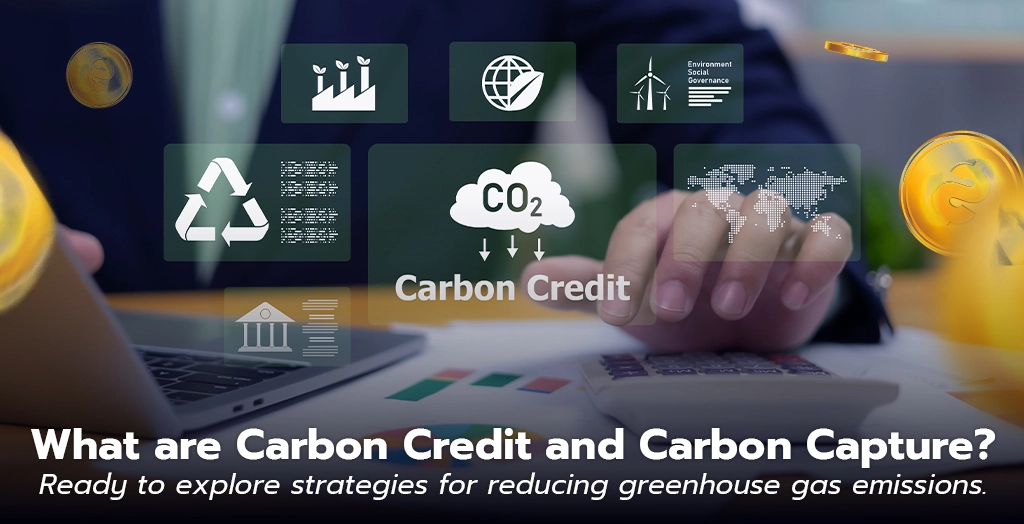
Global warming and climate change are among the most urgent issues facing our planet. To address these challenges, two key solutions have emerged — Carbon Credit and Carbon Capture.
These mechanisms not only help reduce greenhouse gas emissions but also open new opportunities for businesses to grow sustainably.
What Is a Carbon Credit?
A Carbon Credit represents a measurable reduction or removal of carbon dioxide (CO₂) emissions, verified and certified by an accredited organization.
In simple terms, one carbon credit equals one ton of CO₂ reduced or absorbed — also known as tCO₂e (tonne of carbon dioxide equivalent).
Certification Bodies
- In Thailand: The Thailand Greenhouse Gas Management Organization (TGO) oversees certification through the T-VER and Premium T-VER programs.
- Internationally: Global standards include Verra (VCS Standard) and Gold Standard (GS4GG).
Once certified, carbon credits can be bought, sold, or traded in the carbon market, either:
- Over-the-counter (OTC), or
- Through formal trading platforms.
In essence, carbon credits transform CO₂ reductions into economic value. Organizations can use them to:
- Offset their emissions, or
- Generate income by selling excess credits.
What Determines the Price of Carbon Credits?
The price of a carbon credit varies based on several key factors:
- Type of Project
- Renewable energy projects (e.g., solar or wind farms) often generate lower-cost credits due to lower production expenses.
- Carbon Capture projects, which use advanced technology, typically have higher prices.
- Certification Standards
- Internationally recognized certifications tend to raise credit value due to higher credibility.
- Market Demand and Supply
- Prices rise and fall depending on global and regional demand for offsets.
- Market Type
- Voluntary Market: Prices are flexible and negotiated between buyer and seller.
- Compliance Market: Prices are regulated by law, such as under the EU ETS, and are usually higher.
- Co-Benefits
- Projects that also provide social or environmental benefits — like community reforestation — often command premium prices.
What Is Carbon Capture?
Carbon Capture refers to the process of capturing CO₂ before it enters the atmosphere.
It relies on advanced technologies that involve three main steps: capture, storage, and utilization.
Main Types of Carbon Capture
- Carbon Capture and Storage (CCS)
Captured CO₂ is stored permanently, often in depleted oil wells or deep geological formations beneath the ocean. - Carbon Capture, Utilization & Storage (CCUS)
Captured CO₂ is reused in other processes before being stored.- Example: CarbonCure (Canada) injects CO₂ into concrete during production to strengthen it.
- Example: Carbon Clean (UK & India) and Tata Chemicals (India) convert CO₂ into soda ash and baking soda.
Carbon Credits from Carbon Capture Projects
Carbon credits generated from Carbon Capture technologies are often more valuable than other types because:
- They involve high technological costs
- Require complex processes and strict verification
- Deliver direct and measurable reductions in greenhouse gas emissions
Despite the higher cost, Carbon Capture is seen as a crucial solution for achieving Net Zero goals, with governments and large corporations investing heavily in its development.
Carbon Credit and Carbon Capture: Beyond Environmental Benefits
Both Carbon Credit and Carbon Capture go beyond being environmental tools — they are powerful business opportunities.
They can:
- Create new revenue streams
- Strengthen brand credibility
- Align organizations with global sustainability standards
In a world moving toward decarbonization, organizations that act early and invest in these areas will gain a lasting competitive advantage — helping build a cleaner, safer, and more sustainable future for all.