In an era where Sustainability drives business strategies, choosing the right eco-friendly packaging is crucial.
However, one of the biggest hurdles for both brands and consumers is navigating the green vocabulary. Terms like Degradable, Biodegradable, and Compostable are often thrown around interchangeably to imply “eco-friendliness.” But underneath the marketing, their degradation mechanisms and environmental end-of-life are worlds apart. Let’s break them down clearly.
1. Degradable: Broken Down, But Not Gone
The word Degradable literally means “capable of being broken down.” In the plastic sector, this term is highly prone to greenwashing if left unqualified.
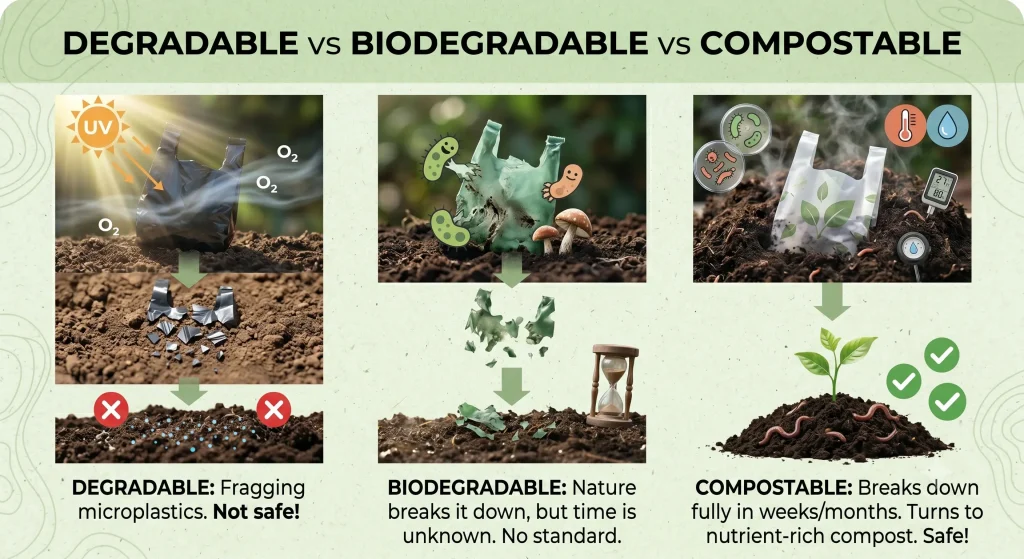
- The Process: These plastics are typically embedded with chemical additives that break polymer chains when exposed to sunlight/UV (Photodegradation) or oxygen (Oxo-degradable). The plastic visually fragments into tiny pieces rapidly.
- The Catch: Out of sight does not mean out of mind. The plastic hasn’t actually disappeared; it has merely converted into Microplastics and Nanoplastics. These invisible synthetic remnants persist in the soil and waterways, eventually bioaccumulating up the food chain.
2. Biodegradable: Nature-Assisted Breakdown (With a Missing Timeline)
A step up from standard fragmentation, Biodegradable means the plastic can be digested by living organisms.
- The Process: Naturally occurring microorganisms (such as bacteria and fungi) tackle the plastic structure, turning it into carbon dioxide, water, and biomass.
- The Limitation: The term Biodegradable does not specify a time frame or required environment. The rate of decomposition depends entirely on ambient factors—temperature, moisture, oxygen levels, and microbial activity. If a biodegradable bag ends up buried in an oxygen-deprived landfill, it could still take decades to break down.
3. Compostable: The Gold Standard of True Circularity
If your brand demands ultimate environmental accountability, Compostable is your target metric. This is one of the strictest environmental standards globally, backed by certifications like EN 13432, ASTM D6400, or ISO 17088.
- The Process: These materials are explicitly engineered to biodegrade under managed composting conditions. International standards mandate that the material must disintegrate and biologically degrade, usually within 180 days in an industrial facility.
- Verified Ecosystem Safety: Beyond speed, compostable plastics undergo strict Ecotoxicity Testing. The resulting compost is tested on seed germination and earthworm survival to guarantee that the material leaves zero toxic residues or heavy metals in the soil.
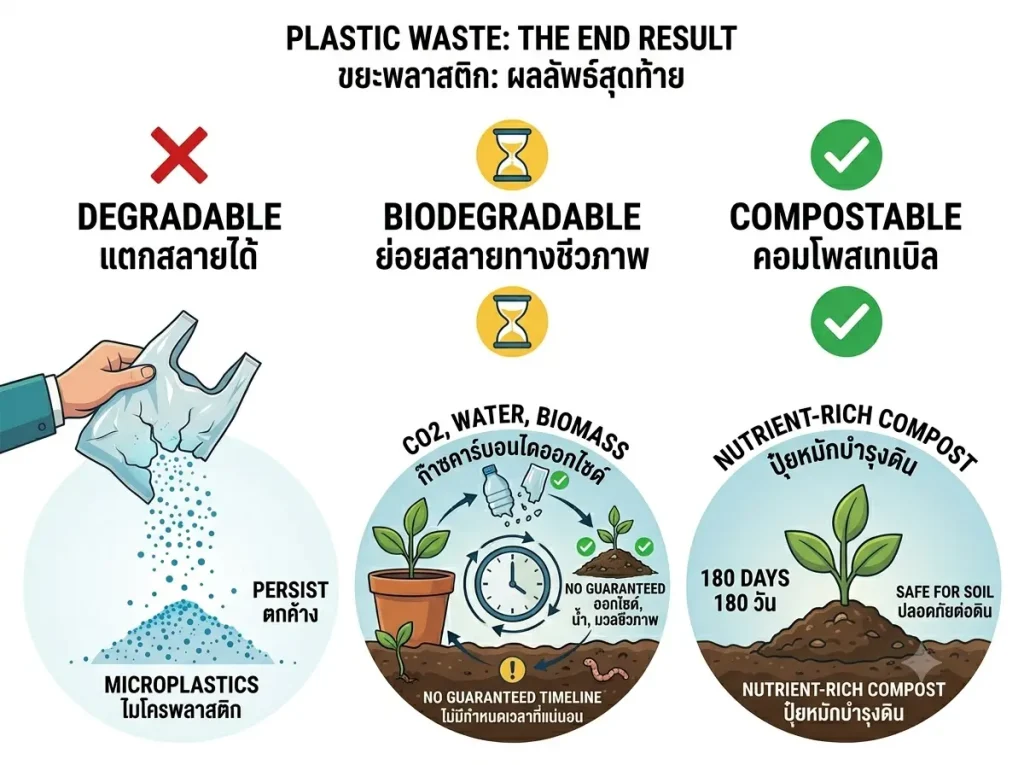
At-a-Glance Comparison Checklist
- Degradable: Breaks big plastics into microplastics. Avoid if possible.
- Biodegradable: Microbes can degrade it, but there is no guaranteed timeline.
- Compostable: Swiftly converts into nutrient-rich compost within a set timeframe. Safe for nature.
FAQ
Q1: Which term should businesses look for to avoid greenwashing on packaging?
A: Look for Compostable, along with official certification logos (such as BPI, TUV Austria, or DIN CERTCO). This ensures the product has been rigorously tested to biodegrade safely without leaving microplastics behind.
Q2: Are Oxo-degradable plastics actually eco-friendly?
A: No. In fact, oxo-degradable plastics have been widely banned in several regions, including the European Union. They accelerate the creation of microplastics, which are incredibly difficult to clean up and pose a severe threat to marine and terrestrial life.
Q3: Can I throw “Compostable” plastic packages into my home backyard garden bin?
A: Check the packaging label carefully. It must specifically state “Home Compostable.” If it only says “Compostable” or “Industrial Compostable,” the item requires the high, sustained heat (50-60 °C) of a commercial composting facility to properly break down. It will not degrade efficiently in a standard backyard pile.