
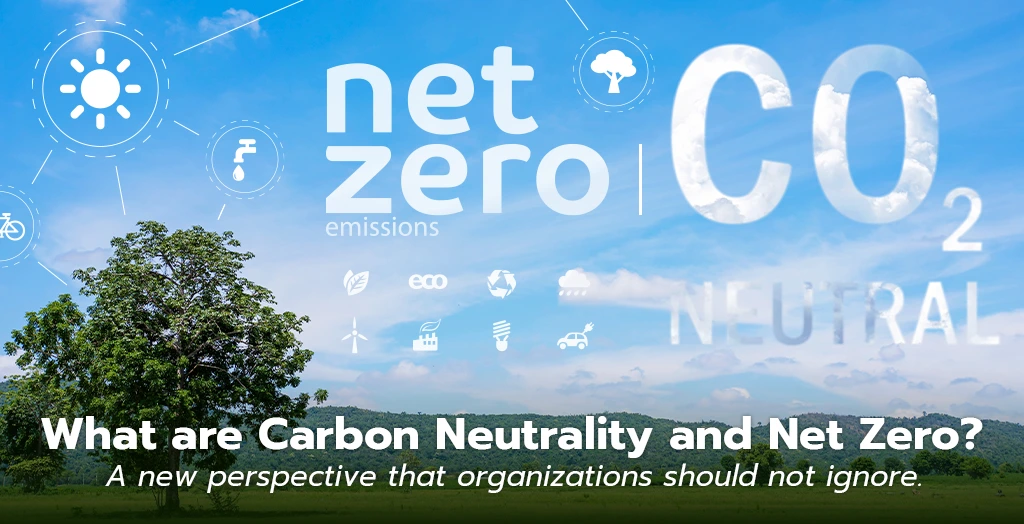
In recent years, Carbon Neutrality and Net Zero Emissions have become global priorities — shaping policies, corporate strategies, and sustainability goals worldwide. Thailand, too, has made strong commitments: achieving Carbon Neutrality by 2050 and Net Zero Emissions by 2065.
But what do these terms really mean? And how are they different? Let’s break it down in simple, practical terms.
What Is Carbon Neutrality?
Carbon Neutrality, or “carbon balance,” means achieving a state where the amount of carbon dioxide (CO₂) emitted equals the amount absorbed or offset — resulting in no net increase of CO₂ in the atmosphere.
In short, it’s about managing only CO₂ emissions, not all greenhouse gases (GHGs).
Organizations can achieve carbon neutrality through:
- Using clean and renewable energy such as solar or wind power
- Offsetting emissions via carbon credits
- Supporting reforestation or other carbon reduction projects
In essence: Carbon Neutrality focuses on balancing carbon dioxide emissions only.
What Is Net Zero Emissions?
Net Zero Emissions takes it a step further. It means the total amount of all greenhouse gases released is equal to the amount removed from the atmosphere — effectively bringing total GHG emissions to zero.
This includes seven major types of greenhouse gases:
- CO₂ (Carbon Dioxide)
- CH₄ (Methane)
- N₂O (Nitrous Oxide)
- HFCs (Hydrofluorocarbons)
- PFCs (Perfluorocarbons)
- SF₆ (Sulphur Hexafluoride)
- NF₃ (Nitrogen Trifluoride)
To achieve Net Zero, organizations aim to reduce emissions as much as possible, then neutralize any remaining emissions through initiatives such as:
- Carbon capture and storage (CCS) technologies
- Forest conservation and restoration projects
- Clean energy transitions
In short: Net Zero is broader — it targets all greenhouse gases, not just CO₂.
Carbon Neutrality vs. Net Zero — What’s the Difference?
| Aspect | Carbon Neutrality | Net Zero Emission |
|---|---|---|
| Scope of GHGs | Focuses on CO₂ only | Covers all greenhouse gases (CO₂, CH₄, N₂O, HFCs, PFCs, SF₆, NF₃) |
| Goal | Balance CO₂ emissions | Balance total GHG emissions |
| Main Approach | Renewable energy, reforestation, carbon credits | Clean energy, carbon capture tech, reducing all GHG types |
| Purpose | Create CO₂ balance | Eliminate total climate impact |
Why Businesses Should Understand the Difference
For modern organizations, understanding the difference between Carbon Neutrality and Net Zero Emission is essential. It helps define the right environmental strategy, align with global sustainability standards, and strengthen corporate reputation.
- Carbon Neutrality is an excellent starting point for reducing your organization’s carbon footprint and demonstrating environmental responsibility.
- Net Zero Emission represents the ultimate goal, addressing all greenhouse gases for long-term sustainability.
The Path Forward
Both Carbon Neutrality and Net Zero are vital to tackling climate change. Thailand’s national goals — and the world’s collective ambition — depend on active collaboration between governments, industries, and communities.
For any organization seeking sustainable growth, the journey should begin with Carbon Neutrality and progress toward Net Zero Emissions — creating real impact for the environment, society, and future generations.